Roth IRA Calculator Tax-Free Wealth Builder

Roth IRA Calculator

See how your after-tax contributions can grow completely tax-free. Visualize your retirement wealth and compare against a regular taxable account in real time.

🧮

Your Details

Adjust sliders or type values

30
65
$10,000
$
$7,000
$
✓ Within 2025 IRS limit ($$7,000)
8%
%
25%
%
Roth IRA Balance at Retirement
$1,450,568

That's $546,862 more than a taxable account

💵
Total Contributed
$255,000
🌱
Tax-Free Growth
$1,195,568
🛡️
Tax Savings
$298,892

Growth Projection

Roth IRA Taxable Account Contributions
Roth IRA $0
Taxable Account $0

Roth IRA vs Taxable Account

🏆 Roth wins by $546,862
Roth IRA (Tax-Free) $1,450,568
Taxable Account (After Tax) $903,707

Estimate Your Roth IRA Growth Over Time

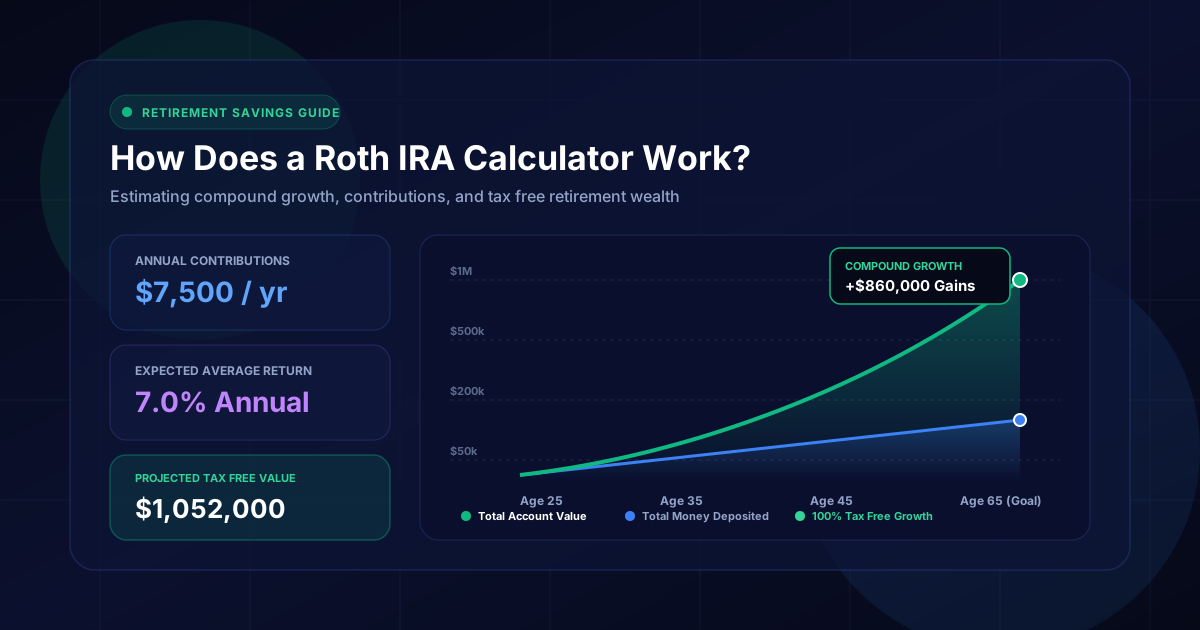
This Roth IRA calculator projects how after-tax Roth IRA contributions grow into tax-free wealth through compound interest. Enter your current age, retirement age, annual contribution, and expected return rate to build your wealth projection in real time. The Roth IRA savings snapshot displays your total balance, contributions, tax-free earnings, and estimated tax savings versus a taxable account.

Roth IRA Compound Growth — $7,000/yr at 8%

Earnings Contributions
10-Year Total: $115,396
Contributed: $70,000
Tax-Free Earnings: $45,396
10 Years
$115,396
20-Year Total: $392,570
Contributed: $140,000
Tax-Free Earnings: $252,570
20 Years
$392,570
35-Year Total: $1,450,568
Contributed: $245,000
Tax-Free Earnings: $1,205,568
35 Years
$1,450,568

Compound interest accelerates Roth IRA growth exponentially — 83% of the 35-year balance comes from tax-free earnings, not contributions.

whatIs.title

whatIs.p1

whatIs.feature1Title

whatIs.feature1Desc

whatIs.feature2Title

whatIs.feature2Desc

whatIs.feature3Title

whatIs.feature3Desc

whatIs.feature4Title

whatIs.feature4Desc

How the Roth IRA Calculator Works

Understanding the mathematics behind compounding, tax savings, and long-term retirement wealth.

01

1. Enter Your Profile

Input your current age, planned retirement age, initial balance, and annual contribution amount.

02

2. Real-Time Compounding

Our algorithm simulates yearly compound interest and applies IRS annual contribution rules dynamically.

03

3. Tax-Free Advantage

We compare your tax-free Roth accumulation against a standard taxable brokerage account subject to annual dividend/capital gains taxes.

steps.title

steps.subtitle

1

steps.step1Title

steps.step1Desc

2

steps.step2Title

steps.step2Desc

3

steps.step3Title

steps.step3Desc

4

steps.step4Title

steps.step4Desc

5

steps.step5Title

steps.step5Desc

How to Fill Out Your Roth IRA Details

Enter your Roth IRA details in the input panel above to calculate your tax-free retirement growth. Your ages determine the compound interest time horizon, annual deposits set yearly savings, and expected return projects wealth accumulation.

Click any step below to scroll directly to that input field.

1

Current Age

Enter your age today to set the starting point for compound interest calculations.

2

Retirement Age

Set your target retirement age. Penalty-free earnings withdrawals begin at age 59½.

3

Annual Contribution

Enter your yearly deposit up to the 2025 IRS limit of $7,000 ($8,000 if age 50+).

4

Expected Return

Set your projected annual return rate (historical S&P 500 average is 8%–10%).

5

Tax Rate

Enter your marginal tax bracket to compare tax-free growth against a taxable account.

FAQ'S

Answers to the 9 most common Roth IRA questions about Roth IRA contribution limits, Roth IRA withdrawal rules, compound interest, Roth IRA income limits, and retirement planning. Each answer references current IRS rules, Roth IRA distribution details, and specific dollar amounts so you can make informed decisions about your Roth IRA strategy.

A Roth Individual Retirement Account (IRA) is an after-tax retirement account offering 100% tax-free growth and tax-free withdrawals in retirement. You contribute post-tax income, and earnings compound without taxes. At age 59½ with a 5-year-old account, all distributions are tax-free. Roth IRAs have no Required Minimum Distributions (RMDs).

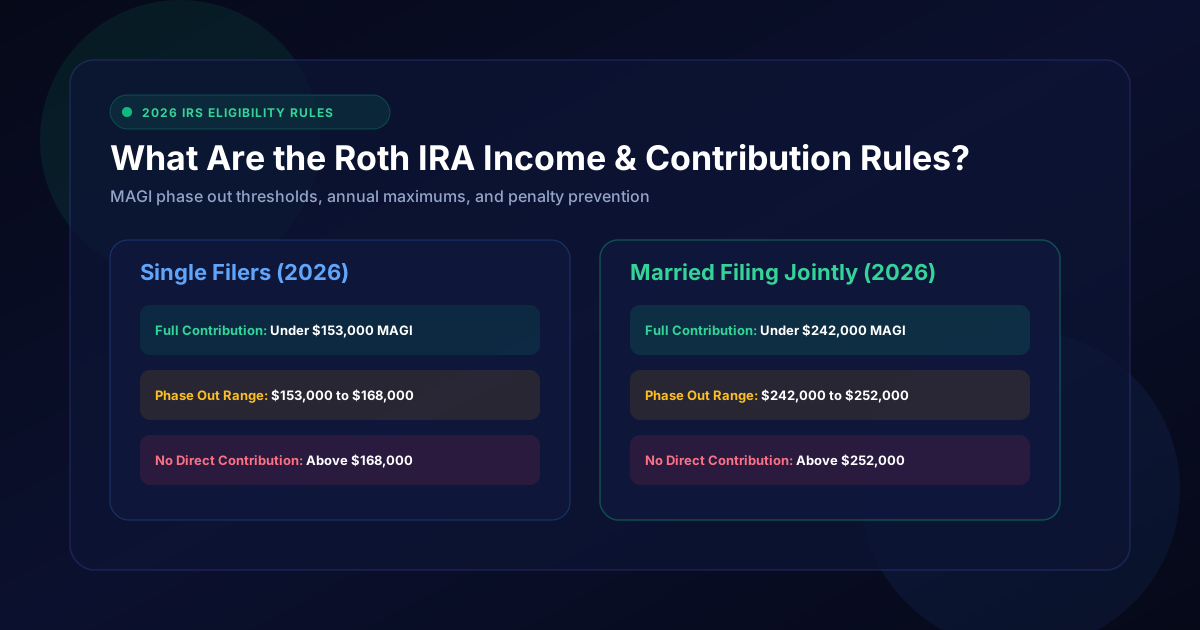
For 2025, you can contribute up to $7,000 annually if under age 50, or $8,000 if age 50 or older ($1,000 catch-up contribution). For 2026, the limit rises to $7,500 ($8,600 for age 50+). Single filers with MAGI over $165,000 and married joint filers over $246,000 cannot make direct contributions in 2025.

You can withdraw original contributions anytime without taxes or penalties. Earnings qualify for tax-free withdrawal once you reach age 59½ and the account meets the Five-Year Rule. Early earnings withdrawals avoid penalties for first-time home purchases (up to $10,000), qualified disability, or higher education expenses.

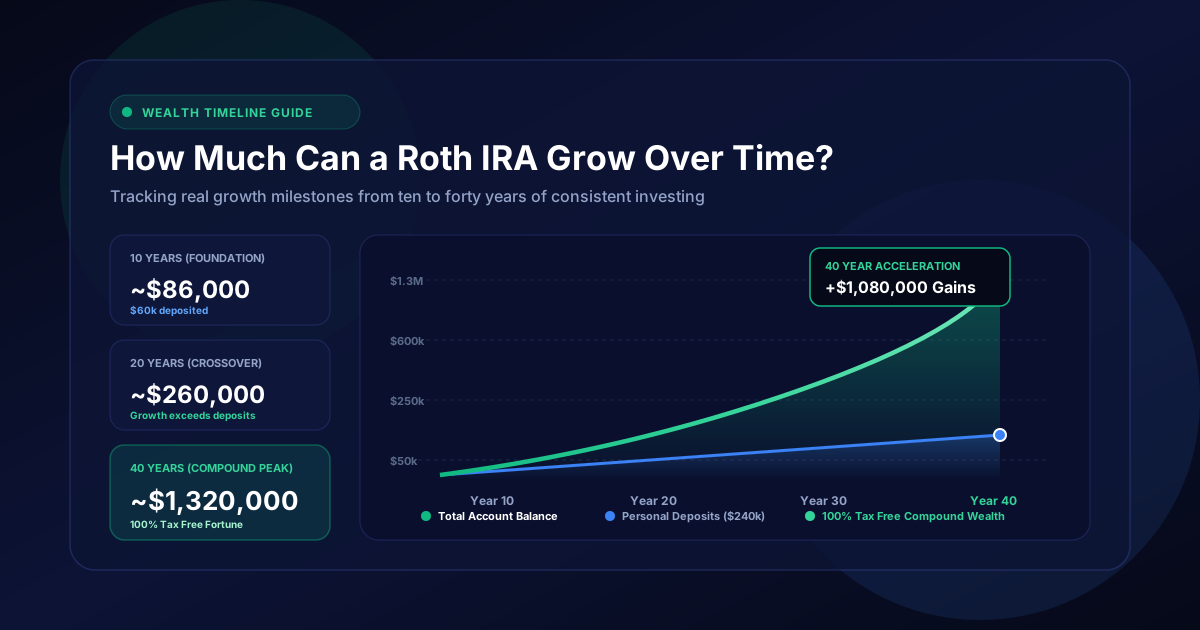
Yes, compound interest drives exponential Roth IRA growth over time. A $7,000 annual contribution at an 8% return grows to $115,396 in 10 years, $392,570 in 20 years, and $1,450,568 in 35 years. Tax-free status prevents tax drag, allowing 100% of your earnings to compound.

Increasing your monthly contribution raises your principal and compounds into significantly higher retirement savings. Adding $100 per month ($1,200 per year) at an 8% return produces approximately $146,000 in additional tax-free wealth over 30 years.

Your return rate determines investment growth speed. Over 30 years with a $7,000 annual deposit, a 6% return yields $586,000; an 8% return yields $849,703; and a 10% return yields $1,266,000. Adjust your return rate in the calculator to model conservative, moderate, or aggressive growth.

Your Roth IRA remains unchanged because it is an individual account held at a brokerage (such as Vanguard, Fidelity, or Charles Schwab), not tied to an employer. You can also roll over a previous employer's Roth 401(k) directly into your Roth IRA without tax penalties.

No, qualified Roth IRA withdrawals in retirement are 100% tax-free. After reaching age 59½ and meeting the Five-Year Rule, you pay zero income tax on distributions. Roth IRAs also have no Required Minimum Distributions (RMDs) during your lifetime.

Yes, you can contribute to both accounts simultaneously. In 2025, you can contribute up to $7,000 to a Roth IRA ($8,000 if 50+) and up to $23,500 to a 401(k) ($31,000 if 50+). This combination provides current-year tax deductions via the 401(k) alongside tax-free retirement growth in the Roth IRA.