How Does Compound Interest Work in a Roth IRA?
Compound interest sounds complicated at first, but it's really just your money making money, and then that new money making even more money afterward. Here's how Roth IRA compounding genuinely functions behind the scenes, explained simply.
Compound interest sounds complicated at first, but it’s really just your money making money, and then that new money making even more money afterward. Here’s how Roth IRA compounding genuinely functions behind the scenes, explained simply.
What Compound Interest Means for Roth IRA Investors
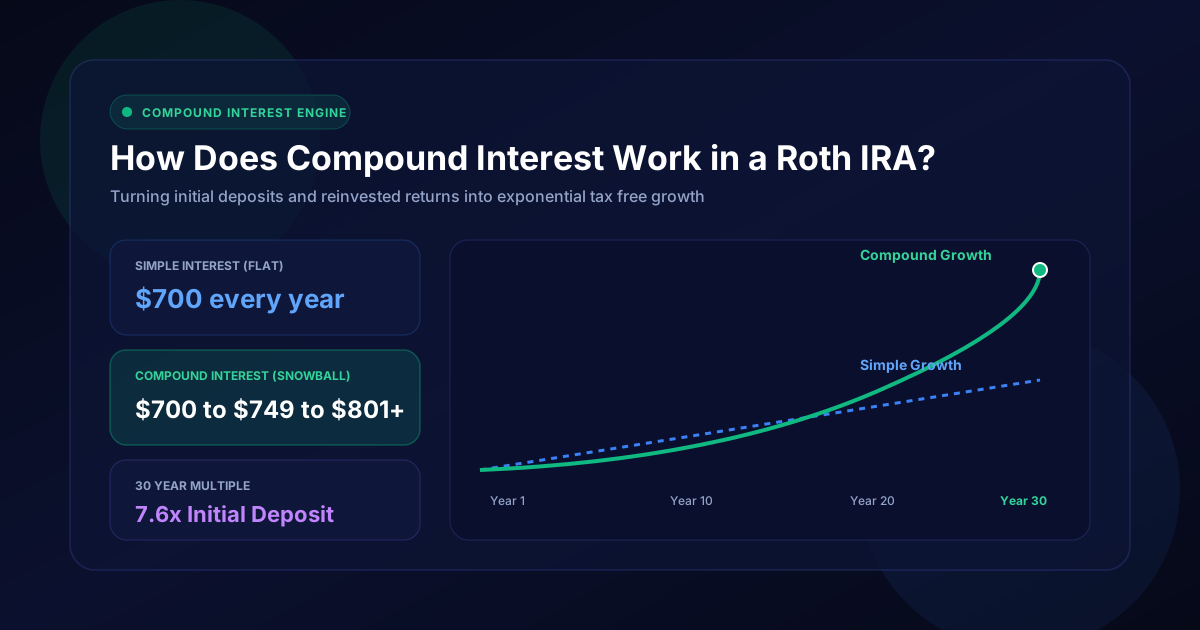
Compound interest is growth earned on both your original principal and all your prior accumulated gains combined. Unlike simple interest, it snowballs steadily over time.
The longer you patiently wait, the bigger and faster that snowball naturally becomes. Simple interest on $10,000 at 7% pays $700 every year, forever. Compound interest pays $700 the first year, then $749, then $801, climbing without limit.
How Your Contributions Generate Investment Growth
Every single dollar deposited quietly becomes its own tiny growth engine over time. Investment earnings don’t just sit still doing nothing useful.
They get reinvested automatically, buying additional shares that then generate even more future earnings for you. A dollar invested at 25 does roughly eight times the work of a dollar invested at 55.
How Reinvested Earnings Create Compounding
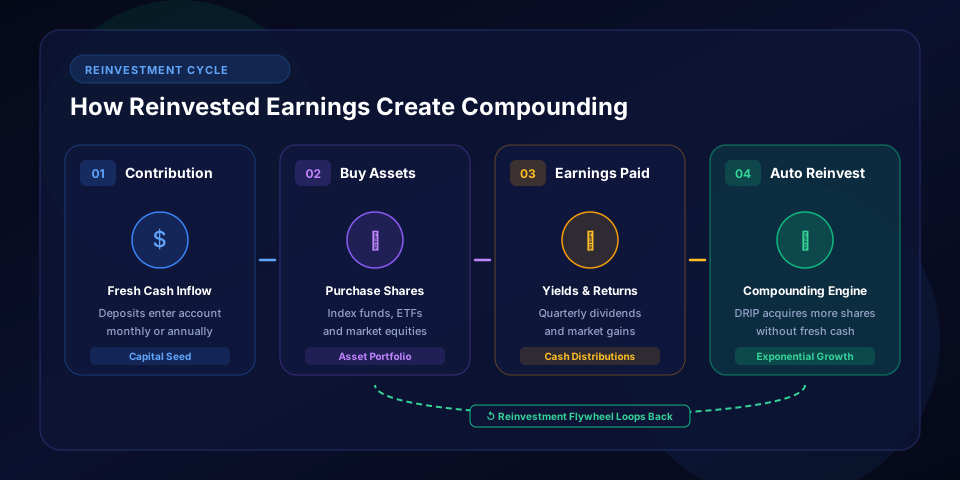
Reinvested returns are genuinely the secret sauce behind all of this. Dividends and gains buy additional shares instead of sitting idle in cash somewhere.
This process creates true exponential growth rather than flat, boring, linear increases over the years. Check that your brokerage has automatic dividend reinvestment switched on, because some accounts default to cash.
Why Time Is So Important for Compound Growth
Albert Einstein reportedly once called compound interest the eighth wonder of the world. Whether he actually said that or not, the sentiment still holds true today.
Long-term investing rewards patience exponentially, not merely proportionally, which makes an enormous difference. Doubling your time horizon does far more than doubling your final balance.
How Monthly Compounding Differs From Annual Growth
Monthly compounding technically grows slightly faster than annual compounding at the exact same stated rate, since gains get reinvested more frequently throughout the year.
The overall difference is small but genuinely real across multiple decades of investing. On $100,000 over thirty years, monthly compounding adds roughly $18,000 versus annual.
How Investment Returns Affect Compound Growth
A higher annual return dramatically changes your final outcome more than most people expect. At 5%, $10,000 grows to about $43,000 over 30 years. At 9%, it reaches roughly $133,000 instead.
Portfolio returns clearly matter enormously here, which is why expense ratios deserve attention too. A 1% annual fee quietly eats a fifth of your final balance.
| Rate of Return | $10,000 After 20 Years | $10,000 After 30 Years |
|---|---|---|
| 5% | ~$26,500 | ~$43,200 |
| 7% | ~$38,700 | ~$76,100 |
| 9% | ~$56,000 | ~$132,700 |
What Happens When You Stop Contributing
Even fully paused contributions keep steadily growing on their own. Compound growth doesn’t strictly require constant new deposits.
Existing investment gains continue reinvesting and building on themselves regardless of whether you add fresh money. A $200,000 balance left alone for fifteen years at 7% becomes roughly $552,000.
How Compounding Works During Retirement
Compounding doesn’t simply stop the moment you retire. Remaining funds keep growing tax-free throughout retirement.
“Retirement isn’t the finish line for your money. It’s just a slower lap.”
That’s exactly why many retirees withdraw only what they truly need, letting the rest quietly keep compounding in the background.
How to Estimate Compound Growth Manually
The basic formula is future value equals principal times one plus the rate, raised to the number of years invested.
It’s genuinely simple math, though admittedly tedious to calculate by hand across multiple decades of contributions.
How a Roth IRA Calculator Models Compounding
A Roth IRA calculator automates that entire formula instantly, layering in monthly contributions and clear future value projections without you ever needing to touch a single manual equation yourself.
Case Study: The Frozen Account
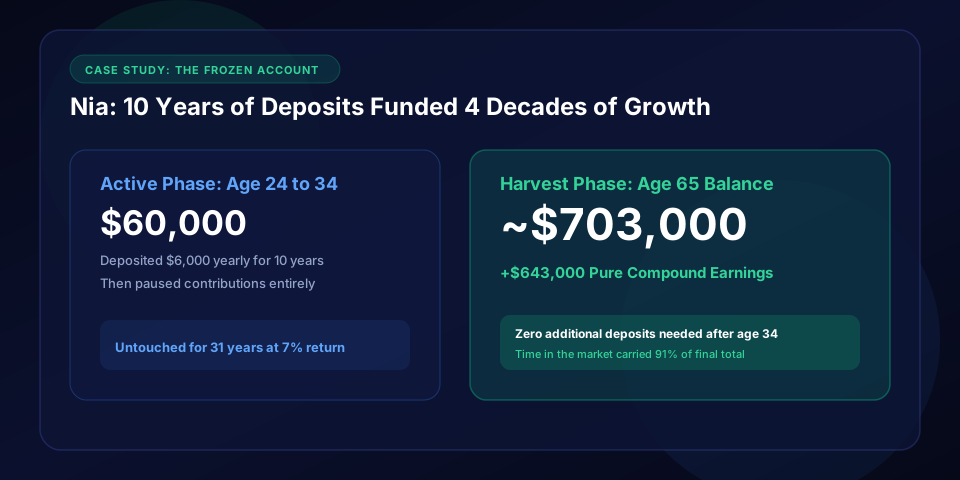
Nia contributed $6,000 annually from 24 to 34, then stopped entirely to raise her children. She never added another dollar. Her $60,000 in contributions, left untouched at 7%, reached approximately $703,000 by age 65. Ten years of deposits funded four decades of growth.
Conclusion
Compound interest is quietly the single most powerful force driving retirement compounding forward over time.
Understanding how it genuinely works helps you appreciate why starting early, and simply staying invested, beats nearly any other competing strategy out there.
Ready to calculate your own tax free retirement savings?
Test different contribution rates, return assumptions, and compare against taxable accounts.